
Advanced Hairfall Treatment in Raipur: Stop Hair Thinning & Regrow Hair
Watching strands of hair collect on your pillow, clog the shower drain, or gradually reveal more of your scalp in the mirror can be deeply frustrating. Hair thinning affects far more than physical appearance; it often impacts self-esteem, professional confidence, and social comfort. In a fast-growing urban hub like Raipur, changing lifestyles, water quality, nutritional gaps, and genetic factors have made premature hair loss a widespread concern among both men and women.
The good news is that modern dermatology and trichology have moved far beyond temporary oils, herbal shampoos, and unverified home remedies. Whether you are dealing with early-stage crown thinning, a receding hairline, or advanced pattern baldness, seeking the best hairfall treatment in Raipur starts with identifying the root cause and matching it with scientifically backed medical or surgical solutions.
At Dermafusion Clinic in Avanti Vihar, Shankar Nagar, patients have access to comprehensive, doctor-led hair restoration combining clinical dermatology with reconstructive surgical precision. Led by board-certified plastic and hair transplant surgeon Dr. Akshay Bora (MBBS, MS, M.Ch. Plastic Surgery) alongside dermatologist Dr. Anugandha Ghatge Bora (MBBS, D.D.V.L.), the clinic addresses both active hair shedding and permanent follicular restoration under one roof.
What Are Hyperpigmentation and Melasma?
Although people often use the terms interchangeably, hyperpigmentation and melasma have distinct clinical characteristics that determine how they should be treated.
1. Hyperpigmentation (General Dark Spots & Uneven Skin Tone)
Hyperpigmentation is an umbrella term used when certain patches of skin become darker than the surrounding area. This occurs when specialized skin cells called melanocytes produce excess melanin—the natural pigment responsible for skin, hair, and eye color. Common forms include:
Post-Inflammatory Hyperpigmentation (PIH): Flat dark brown or black marks left behind after skin inflammation or injury, such as acne breakouts, eczema, insect bites, waxing burns, or aggressive scrubbing.
Solar Lentigines (Sunspots): Well-defined tan-to-dark-brown spots caused by cumulative ultraviolet (UV) exposure over the years, typically appearing on the face, hands, and forearms.
Periorbital & Perioral Pigmentation: Darkening around the eyes or mouth, frequently worsened by dryness, friction, allergies, or nutritional deficiencies.
2. Melasma (Hormonal & Heat-Driven Patchy Discoloration)
Melasma is a chronic, recurring form of hyperpigmentation characterized by symmetrical, blotchy brown or slate-grey patches. It most commonly appears on:
The bridge of the nose and cheeks (malar pattern)
The forehead, chin, and upper lip (centrofacial pattern)
The jawline (mandibular pattern)
Unlike simple sunspots, melasma involves both overactive pigment cells and underlying vascular (blood vessel) changes in the dermis. Because of this deeper biological activity, people often search for a permanent melasma cure—when in reality, successful care requires targeted medical clearance followed by disciplined long-term maintenance.
Why Is Hairfall Increasing in Raipur? Common Root Causes
Before starting any hair loss treatment in Raipur, an accurate diagnosis is essential. Treating genetic baldness with vitamin supplements alone—or jumping straight to surgery for temporary stress-related shedding—will never yield lasting results. During a clinical scalp evaluation, doctors typically look for the following primary triggers:
1. Androgenetic Alopecia (Male & Female Pattern Baldness)
Androgenetic alopecia is the most common cause of progressive hair thinning. In men, it typically presents as a receding M-shaped hairline and thinning at the crown. In women, it usually manifests as a widening central part and diffuse thinning across the top of the scalp. This condition is driven by sensitivity to Dihydrotestosterone (DHT), a hormone that gradually shrinks hair follicles (miniaturization) until they stop producing visible hair.
2. Telogen Effluvium (Stress, Illness, and Lifestyle Shedding)
High work stress, post-viral recovery (such as dengue, typhoid, or severe fevers), crash dieting, and sudden weight loss can shock a large percentage of growing hairs into the resting (telogen) phase simultaneously. Two to three months after the trigger, patients experience sudden, alarming clumps of hair shedding. Fortunately, telogen effluvium is largely reversible with targeted medical care.
3. Nutritional Deficiencies
Even with a regular diet, deficiencies in iron (low serum ferritin), Vitamin D3, Vitamin B12, zinc, and essential amino acids are extremely prevalent in Central India. Hair follicles are among the fastest-dividing cells in the body; when micronutrient stores drop, the body diverts nutrients away from hair production to vital organs.
4. Hormonal Imbalances (PCOS and Thyroid Disorders)
In women, Polycystic Ovary Syndrome (PCOS), postpartum hormonal shifts, and hypothyroidism or hyperthyroidism frequently trigger chronic hair thinning. Addressing internal hormonal health alongside topical or regenerative scalp therapies is crucial for sustained regrowth.
5. Local Environmental & Scalp Factors
Hard water mineral buildup, humidity, dust exposure, and untreated dandruff (seborrheic dermatitis) create chronic micro-inflammation around hair follicles. Over time, persistent scalp inflammation weakens the hair root and accelerates shedding.
When Should You See a Hair Specialist in Raipur?
Many individuals delay professional care for years, experimenting with over-the-counter serums while hair follicles quietly miniaturize beyond repair. You should schedule a medical consultation if you notice any of the following warning signs:
Shedding more than 100–150 hairs per day consistently for over four weeks.
Noticeable widening of your hair partition or visible scalp under bright indoor lighting.
A receding temple hairline or thinning vertex (crown area).
Circular or patchy bald spots (which may indicate alopecia areata).
Persistent scalp itching, flaking, redness, or pain accompanying hair fall.
A strong family history of early-onset baldness.
Early intervention preserves existing follicles. Once a follicle completely scars over and disappears, non-surgical therapies can no longer revive it—making surgical restoration the only option for that area.
Non-Surgical Hair Loss Treatment in Raipur
When hair follicles are completely lost—such as in Norwood Grade 3 to Grade 7 male pattern baldness, deep temple recessions, or scarring alopecia—non-surgical treatments cannot grow new hair on bald skin. In these cases, a hair transplant in Raipur offers a permanent, natural-looking solution.
How Hair Transplantation Works
Hair transplantation relies on the principle of donor dominance. Hair follicles located on the back and sides of the scalp (the occipital and parietal zones) are genetically resistant to DHT. When relocated to balding areas on the front or crown, these follicles retain their genetic resistance and continue growing naturally for a lifetime.
Advanced Techniques Offered
FUE (Follicular Unit Extraction): The gold standard in modern hair restoration. Individual follicular units (containing 1 to 4 hairs) are extracted directly from the donor area using ultra-fine micro-punches. FUE leaves no linear scar, offers rapid healing within 5 to 7 days, and allows patients to wear short hairstyles comfortably.
FUT (Follicular Unit Transplantation): Recommended for select cases requiring maximum graft yield in a single session or when donor density needs careful preservation. A thin strip of tissue is harvested and dissected under high-magnification stereomicroscopes to preserve every graft’s integrity.
Beard, Eyebrow & Moustache Restoration: Precision follicular implantation to fill patchy facial hair or restore eyebrows thinned by over-plucking, trauma, or burns.
Permanent Hair Transplant in Raipur: Surgical Restoration
For patients in the early to moderate stages of hair thinning, non-surgical therapies strengthen weakened follicles, prolong the active growth (anagen) phase, and improve overall hair shaft thickness.
1. Customized Medical & Topical Therapy
A personalized prescription regimen forms the backbone of medical hair management. Depending on your scalp health, age, and medical history, your doctor may prescribe:
FDA-Approved Vasodilators: Topical or low-dose oral formulations that increase blood flow and nutrient delivery to dormant follicles.
DHT Blockers: Targeted medical therapies (for appropriate candidates) that protect genetically vulnerable follicles from hormonal miniaturization.
Peptide & Procapil Serums: Drug-free, clinically tested formulations that anchor the hair root and reduce inflammation.
Targeted Nutraceuticals: Bioavailable biotin, iron, zinc, marine collagen, and Vitamin D3 tailored to your blood work rather than generic multivitamins.
2. Platelet-Rich Plasma (PRP) Therapy
PRP therapy harnesses your body’s own healing mechanisms to stimulate hair regrowth. A small sample of your blood is drawn and spun in a specialized medical centrifuge to isolate platelet-rich plasma—a golden concentration packed with vascular endothelial growth factor (VEGF), platelet-derived growth factor (PDGF), and epidermal growth factor (EGF).
When micro-injected into thinning zones of the scalp, these growth factors repair damaged follicles, stimulate new blood vessel formation, and thicken miniaturized hair strands. A standard protocol involves 4 to 6 sessions spaced 3 to 4 weeks apart, followed by occasional maintenance sessions.
3. Growth Factor Concentrate (GFC) Treatment
GFC is an advanced, next-generation evolution of PRP therapy. Instead of injecting whole plasma, specialized activation kits extract pure, high-concentration growth factors directly from your platelets while filtering out red and white blood cells that can cause post-procedure inflammation.
Why patients prefer GFC:
Higher concentration of pure regenerative growth factors per milliliter.
Virtually painless compared to conventional PRP, with minimal post-session swelling.
Faster visible reduction in hair fall—often noticeable within 2 to 3 sessions.
Zero risk of allergic reaction since it is 100% autologous (derived from your own blood).
4. Mesotherapy & Microneedling for Scalp Rejuvenation
Scalp mesotherapy delivers a customized cocktail of vitamins, amino acids, coenzymes, and vasodilators directly into the mesoderm (middle layer of the skin) where hair roots reside. When paired with medical microneedling, micro-channels trigger a controlled wound-healing cascade that boosts collagen production and increases topical serum absorption by up to 80%.
5. Low-Level Laser Therapy (LLLT)
LLLT utilizes safe, cool red-light wavelengths to stimulate cellular metabolism (ATP production) inside sluggish hair follicles. It is completely non-invasive, painless, and works effectively as an adjunct therapy alongside PRP, GFC, or post-hair transplant recovery.
Why Choose Dr. Akshay Bora for Hair Treatment in Raipur?
Choosing the right doctor is the single most critical factor determining whether your results look completely natural or noticeably artificial. Unqualified technician-run clinics often suffer from poor graft survival, unnatural straight hairlines, and depleted donor areas.
Patients searching for Dr. Akshay Bora hair treatment at Dermafusion Clinic benefit from specialized surgical and dermatological credentials:
Super-Specialist Surgical Qualifications: Dr. Akshay K. Bora holds an M.Ch. in Plastic & Reconstructive Surgery from Osmania General Hospital, Hyderabad, alongside an M.S. in General Surgery and Fellowship training in Aesthetic Surgery from New Delhi. He is a lifetime member of the Association of Plastic Surgeons of India (APSI) and the Indian Association of Aesthetic Plastic Surgeons (IAAPS).
Artistic Hairline Design: Creating a natural hairline requires an aesthetic surgeon’s understanding of facial proportions, age-appropriate temple angles, and single-hair vs. multi-hair graft distribution. Single-hair grafts are placed softly at the leading edge, transitioning smoothly into denser multi-hair units behind them.
Dual Dermatologist + Plastic Surgeon Advantage: Because Dr. Akshay Bora practices alongside dermatologist Dr. Anugandha Ghatge Bora at Dermafusion Clinic, patients receive an integrated diagnosis. Underlying scalp infections, hormonal imbalances, and medical hair thinning are treated medically so your native hair stays strong alongside transplanted grafts.
Strict Hygiene & Doctor-Led Protocols: Every consultation, hairline design, recipient site creation, and critical surgical step is personally supervised and executed by qualified specialists using US-FDA approved equipment.
Comparison: Non-Surgical Treatments vs. Hair Transplant
| Feature | Non-Surgical (PRP / GFC / Medical) | Surgical (FUE / FUT Hair Transplant) |
| Best For | Early thinning, diffuse shedding, weak roots | Bald patches, receding hairline, advanced hair loss |
| Downtime | Zero downtime; return to work immediately | 3–5 days of mild social downtime |
| Procedure Duration | 30 to 45 minutes per session | 4 to 8 hours (single day-care procedure) |
| When Results Appear | Reduced hairfall in 4–6 weeks; thickening in 3–4 months | New growth starts at 3–4 months; full density at 9–12 months |
| Longevity | Requires periodic maintenance sessions | Permanent natural hair growth |
Step-by-Step Patient Journey at Dermafusion Clinic
If you are looking for trusted hairfall treatment near me in Raipur, knowing what happens during your visit removes guesswork and anxiety:
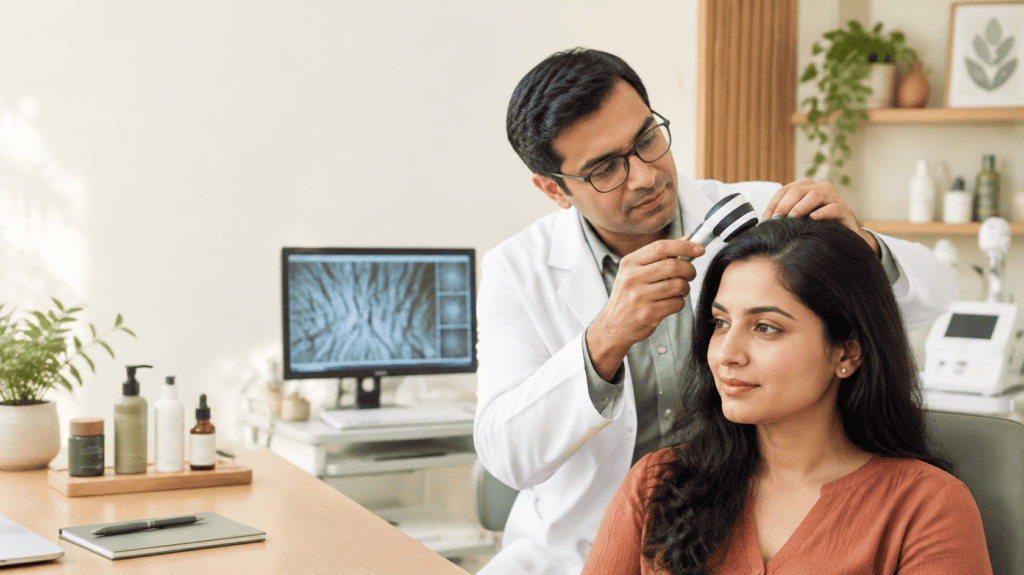
Trichoscopy & Scalp Analysis: High-magnification digital examination of your scalp to measure hair shaft diameter, follicular density, and donor area capacity.
Root-Cause Diagnostic Screening: Review of medical history, family patterns, lifestyle, and targeted blood tests (if nutritional or hormonal factors are suspected).
Customized Roadmap & Transparent Pricing: Honest guidance on whether medical therapy, GFC/PRP, or a hair transplant will deliver the best value and outcome—with clear, upfront cost estimates and zero hidden charges.
Comfortable Procedure Execution: Performed in a sterile clinical suite in Avanti Vihar, Shankar Nagar under local anesthesia for maximum comfort.
Structured Aftercare & Follow-Ups: Detailed post-procedure washing instructions, medication schedules, and regular progress tracking over 6 to 12 months.
Daily Habits to Protect Your Hair Results
Clinical treatments deliver dramatic improvements, but daily habits help protect your investment:
Wash with Lukewarm or Filtered Water: Avoid hot showers on your scalp, which strip natural protective lipids. If your area has hard water, consider a shower filter or final rinse with RO water.
Prioritize Protein & Iron: Hair is made of keratin, a structural protein. Include lentils, paneer, eggs, lean meats, nuts, and leafy greens in your daily meals.
Avoid Tight Hairstyles & Harsh Heat: Tight ponytails, helmets worn over sweaty hair without a cotton liner, and frequent high-heat styling cause traction and thermal breakage.
Manage Stress & Sleep: Aim for 7–8 hours of quality sleep so cortisol levels stay balanced and cellular repair peaks overnight.
Frequently Asked Questions
1. Which is the best hairfall treatment in Raipur for early hair thinning?
For early-stage hair thinning where follicles are still active, a combination of targeted medical therapy, nutritional correction, and Growth Factor Concentrate (GFC) or PRP sessions delivers the strongest results. GFC stimulates dormant roots without surgery or downtime.
2. How much does a hair transplant cost in Raipur?
The cost of a hair transplant in Raipur typically ranges from ₹30,000 to ₹1,20,000+, depending on the degree of baldness (Norwood grade), total number of grafts required, and whether FUE or combined techniques are used. An exact quote is provided after a physical scalp and donor examination.
3. Is hair transplant surgery painful, and how long is recovery?
Hair transplant procedures are performed under local anesthesia, so you remain awake and comfortable throughout the session with minimal discomfort. Most patients resume desk work within 3 to 4 days, and tiny scabs shed naturally within 7 to 10 days.
4. How many sessions of PRP or GFC are needed to stop hairfall?
Most patients require 4 to 6 sessions spaced 3 to 4 weeks apart for optimal density and hairfall control. Noticeable reduction in daily shedding usually begins after the second session, while visible thickening appears around 3 to 4 months.
5. Are hair transplant results permanent?
Yes. Because transplanted follicles are harvested from the permanent donor zone at the back and sides of your scalp—which is genetically resistant to DHT—the newly grown hair continues to grow naturally for life. You can cut, wash, and style it just like your original hair.
6. Where can I consult Dr. Akshay Bora for hair loss treatment in Raipur?
You can consult Dr. Akshay K. Bora at Dermafusion Clinic, located on the 2nd Floor, Vidhya Plaza, ATM Chowk, Avanti Vihar, Shankar Nagar, Raipur, Chhattisgarh 492001. The clinic is easily accessible from Shankar Nagar, Avanti Vihar, VIP Road, Telibandha, Civil Lines, Devendra Nagar, Pandri, and Samta Colony.
Take the First Step Toward Healthier, Fuller Hair
Hair loss is progressive—the earlier you intervene, the more natural hair you can save without needing extensive surgical restoration. Whether you want to halt sudden shedding, thicken thinning hair with GFC/PRP, or restore a receding hairline permanently, expert medical guidance makes all the difference.
Book your personalized scalp consultation with Dr. Akshay Bora at Dermafusion Clinic, Avanti Vihar, Shankar Nagar, Raipur today and get a clear, science-backed plan tailored to your hair goals.
Unveil Your Most Beautiful Self.
Cosmetic Services
Dermafusion Clinic — Best Hairfall Treatment in Raipur
01
02
03
04


